
Washington Palm Trees
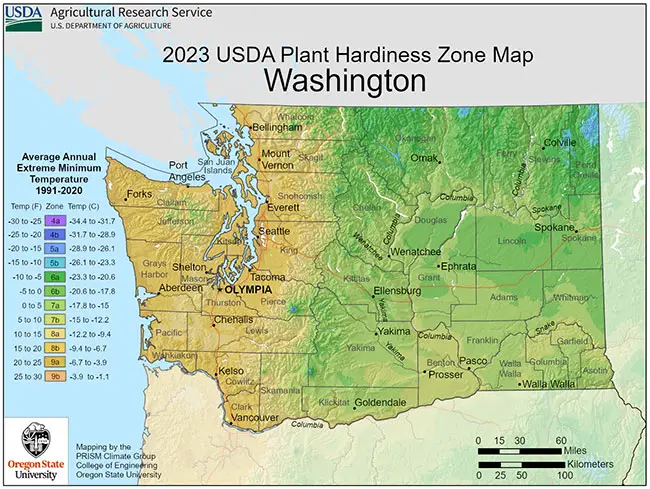
You can indeed grow palm trees in the warm parts of Washington state. Washington has a mild climate, and it’s divided into two main regions: the western part, which has an oceanic climate, and the eastern part, which leans more towards a continental climate. The Cascade Mountains split the state.
In the western region, the average January temperatures range from 20°F (–7°C) to 48°F (9°C), while July temperatures typically vary between 44°F (7°C) and 80°F (27°C). In the eastern region, average January temperatures range from 8°F to 40°F (–13°C to 4°C), and July temperatures range from 48°F to 92°F (9°C to 33°C).
On average, the state receives between 11.4 inches to 49.4 inches (29 cm to 125.5 cm) of snow each year. From October to March, Washington experiences heavy rainfall. The highest temperature ever recorded in the state was 118°F (48°C), and the lowest was –48°F (–44°C). The USDA hardiness zones in Washington range from 4a to 9a.
Growing Palm Trees in Washington
There are a lot of cold hardy palms that can grow in the zones 8 and 9 of Washington state. Here are palm trees that can grow in Washington:
- California Fan Palm Tree – Zones 8b -11 (15 to 20 F)
- Canary Island Date Palm Tree – Zones 8b -11 (15 to 20 F)
- Chinese Fan Palm Tree – Zones 8a – 11 (10 to 15 F)
- True Date Palm Tree – Zones 8b -11 (15 to 20 F)
- European Fan Palm Tree – Zones 7b – 11 (5 to 10 F)
- Mexican Fan Palm Tree – Zones 8b -11 (15 to 20 F)
- Queen Palm Tree – Zones 8b -11 (15 to 20 F)
- Saw Palmetto Palm Tree – Zones 7a -11 (0 to 5 F)
- Silver Saw Palmetto Palm Tree – Zones 7a – 11 (0 to 5 F)
More Palm Trees»
Major Cities in Washington
Bellevue – Hardiness Zone 9a
Seattle – Hardiness Zone 9a
Spokane – Hardiness Zone 5a
Tacoma – Hardiness Zone 9a
Vancouver – Hardiness Zone 7b
Yakima – Hardiness Zone 5b
Looking at palms for our new pool in West Valley, Yakima Washington. The property has no mature trees or landscaping and is on the south slope on the north side of Cottonwood Canyon.
Palm trees for Richland Wa. 99352
Is it ok to skin palms in colder climates(lake Stevens Wa) or is it better to not skin for better insulation? Thanks
Hello,
We are visiting Sonoma and want to bring 2 small palm trees home to plant in Seattle.
Can we bring palm trees across the state line?
Thanks
Julie
Was thinking about getting a canary palm,true date palm and a Sylvester palm.
I was wondering since I live in Zone 8b with winters that are very rainy will they survive.
Id like to grow an outdoor palm tree in a quite large ceramamic pot. in Seattle.
What palm or palmetto do you recommend.
i am originally from SC and miss that tropical feeling that palms give.
Thank you,
Sarah